Developmental psychology
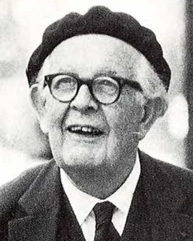
Jean Piaget
1896–1980
A short biography
The Swiss researcher Piaget studied how children construct knowledge. Observation and conversations with children were important parts of his work on cognitive development.
Piaget investigated how children reasoned rather than merely scoring answers as right or wrong. Interviews and tasks treated children’s explanations as meaningful evidence about development.
What does this figure represent in psychology?
He represents investigating children’s thinking rather than treating it simply as an incomplete copy of adult thought.
Schemas, assimilation and accommodation describe the organisation of knowledge through experience. Developmental stages were influential, but performance can vary with task language, culture and support; fixed ages should not be imposed on every child.
Key concepts
Assimilation: interpreting experience through an existing schema. Accommodation: changing the schema in response to experience.
A question for the reader
How can an incorrect answer provide evidence about a child’s reasoning rule?
Selected works and publications
Links lead to original texts, institutional catalogues or publication records; not every link provides a free full text. Work titles are retained in their original or established language.
Reading in context
Developmental accounts should not become a fixed timetable or a single achievement standard for every child.
Sources
Source check: 16 October 2026. Institutional biographies and accessible bibliographic records were consulted; some records were checked through indexed summaries. Complete works were not all read. Concept connections and questions were written for this collection.